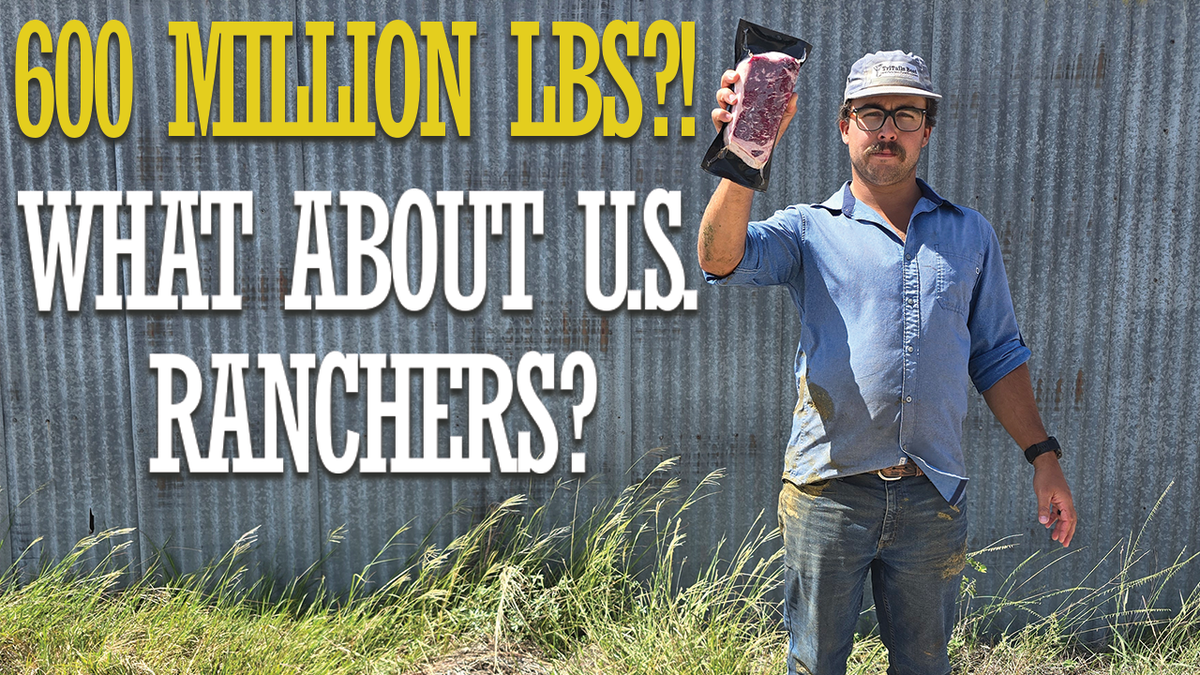
600 Million Pounds of Imported Beef: What Does It Mean for American Ranchers?
All right, folks, welcome to this week’s Cowboy Corner!
We want to welcome you into our big, warm ranching family here at Harrell Ranch in the Texas Panhandle—all six generations of us.
Okay, maybe not all six generations. But three of us are here today carrying on what is now a sixth-generation family ranch, and we’ve got some really interesting things to talk about this week.
We’re dipping our toes into a little bit of politics, which we normally don’t do around here. President Trump is bringing 300,000 metric tons—more than 600 million pounds—of imported beef into America, and as American ranchers, we’ve got some thoughts.
Now, you’re not going to find one single opinion on this across the entire cattle industry. This is my hot take. It comes from my own experience here on the ranch, conversations within our family, and what I see happening in the cattle business.
You can read the whole rant right here, or if you’d rather listen to me rant it off myself, click the YouTube thumbnail above or below.
Either way, sit back and enjoy. We’re talking imported beef, cattle prices, the real cost of keeping an American ranch running, whether this whole thing is being blown out of proportion, and why I believe American family farms and ranches are one of the most important things we can preserve.
And, of course, this week’s Cowboy Corner is brought to you by TriTails Premium Beef.
First Things First: We’re 100% American Beef
Before we dive in, let me remind y’all of something we’re mighty proud of.
At TriTails, our beef is 100% American beef.
It comes from American ranchers. It’s processed in America. It’s packaged in America. And it’s shipped straight from our sixth-generation family ranch here in the Texas Panhandle to your front door.
That’s American beef, folks.
No foreign beef mixed in. And we believe the quality shows it.
So, if you haven’t given TriTails a try yet, check out the store and give our beef a shot. I don’t think you’ll regret it.
Now, let’s get into this week’s rant.
First, It’s Dry in the Texas Panhandle
Before we get to imported beef, let’s talk about what’s happening right here at home.
I’m standing out in one of our hay fields, and things aren’t exactly where we’d like them to be.
The hay is about knee high right now.
We’d really like it to be shoulder high.
Thankfully, we finally got about two inches of rain last week, so hopefully that’s the difference we need to get some more growth out of it. A lot of this grass is still curled up and hasn’t fully leafed out.
It’s been a rough summer here in the Texas Panhandle.
And drought actually brings us right into this conversation because it demonstrates something people outside agriculture don’t always see:
There is an incredible amount of risk and overhead involved in raising cattle.
Rainfall, drought, feed, fertilizer, diesel, equipment, cattle markets—we don’t get to control all of it.
And every one of those things ultimately affects what it costs us to put beef on America’s tables.
So, Why Are Ranchers Concerned About Imported Beef?
The basic concern is pretty straightforward.
When you bring more beef into America, you’re adding supply to the market.
And when you add more supply, you risk pushing prices down.
Now, if you’re the consumer standing in the grocery store looking at expensive ground beef, lower prices sound pretty dang good.
I understand that.
But there’s another person on the other end of that steak.
The rancher.
We have to sell our cattle at a price that allows us to keep these ranches alive and functioning.
And I think there’s a misconception out there sometimes about ranchers and how much money we’re supposedly making.
You might see us driving a nice Ford F-350 down the highway and think, Man, those ranchers must be doing pretty well.
But that truck isn’t sitting in the driveway because we thought it would be fun to own.
We need that truck.
We’ve got to pull trailers. We’ve got to haul cattle. We’ve got heavy equipment that has to be moved.
The same goes for the tractors and equipment you see around a ranch. They aren’t toys. They’re part of our livelihood.
And behind all of that is an incredible amount of overhead.
Feed gets expensive.
Fertilizer gets expensive.
Diesel gets expensive.
Equipment gets expensive.
And we still have to keep the ranch running.
So cattle prices matter—a lot.
If all of our expenses stay high while the price we receive for our cattle gets pushed down, it becomes harder and harder for an American ranch to make the numbers work.
That’s why you’re hearing concern from ranchers over bringing hundreds of millions of additional pounds of foreign beef into the market.
Does cheaper beef benefit the consumer in some ways?
Sure.
But if the way we get there is by hurting the American rancher who is actually producing our food, I don’t think that’s much of a long-term solution.
And Let’s Talk About the Beef Itself
There’s another piece of this that concerns me: the beef itself.
Imported beef can come from a completely different production and regulatory system than the beef we’re raising here in America. There can be differences in grading, standards, regulations and how those cattle were raised.
That matters.
And it’s one of the reasons I keep coming back to something very simple:
Know where your beef comes from.
Know who raised it.
Know where it was processed.
Know what you’re feeding your family.
There’s value in that beyond simply finding the cheapest pound of beef sitting in the grocery store.
Beef Is a Premium Product
Now I’m going to say something that might ruffle a few feathers.
The next time you’re in the grocery store getting upset about the price of ground beef, walk down the chip aisle.
Grab a bag of Doritos.
Then figure out what those Doritos cost per pound.
Now compare that to a pound of ground beef.
Seriously.
Think about that for a minute.
Beef is a high-quality, premium product. It always has been.
It isn’t an apple you picked off a tree. It isn’t a bag of chips.
Think about what it actually takes to produce that pound of beef.
It takes land.
It takes grass.
It takes feed.
It takes water.
It takes equipment.
It takes labor.
It takes risk.
And, most importantly, it takes years of somebody caring for and raising that animal.
Beef is packed with protein, amino acids and nutrition, and it takes an incredible amount of work to produce.
So when a pound of Doritos starts getting anywhere close to what you’re paying for a pound of ground beef, I start scratching my head a little bit.
Now, don’t misunderstand me.
I don’t think beef should be crazy expensive.
We don’t want that either.
But the price of beef does need to reflect what ranchers actually go through to produce it.
So instead of only asking:
“How do we make beef cheaper?”
I think we need to ask:
“How do we make beef more affordable for the consumer while still making it fair for the rancher?”
Want to Lower Beef Prices? Lower the Cost of Raising Beef.
This is where I think we need to focus.
If we really want to bring beef prices down for American families, then let’s start with what it actually costs us to raise cattle.
Let’s talk about fertilizer.
You might be thinking, Well, cows don’t eat fertilizer.
No, but look at where I’m standing.
I’m standing in a hay field.
This hay takes fertilizer to grow. The crops that eventually become cattle feed take fertilizer to grow.
When fertilizer gets expensive, feed gets expensive. Hay gets expensive. And ultimately, raising cattle gets more expensive.
Then there’s diesel and fuel.
Ranches don’t operate without them.
We’re running tractors. We’re driving trucks. We’re pulling trailers. We’re hauling cattle. We’re moving feed. We’re operating equipment.
Fuel touches just about everything we do.
And I’m not going to pretend to solve international politics in a Cowboy Corner, but I’ll say this:
I think we ought to be drilling more oil right here in America.
We have the resources.
Drill here. Drill in the Gulf. Produce more of what we need at home.
I understand there are people who have environmental concerns about drilling, but oil is being produced somewhere. And if we’re going to use it anyway, I think there’s a pretty strong argument for producing more of it here instead of putting it on an oil tanker and hauling it halfway across the world.
Because if you want cheaper beef, make it cheaper for American ranchers to produce beef.
Lower fertilizer costs.
Lower feed costs.
Lower diesel costs.
Lower the cost of running the ranch.
Then we can actually talk about bringing down the price consumers pay without simply taking that money out of the rancher’s pocket.
To me, that makes a whole lot more sense.
Now Here’s the Twist: Is This Whole Thing Being Blown Out of Proportion?
After all of that ranting, here’s where I might surprise you.
I also think this particular story may be getting blown a little out of proportion.
Six hundred million pounds sounds like an absolutely staggering amount of beef.
And it is a lot of beef.
But think about how many people live in America.
There are hundreds of millions of us.
If you spread that amount across the entire American population, suddenly you start realizing that it may not last nearly as long as that giant headline number makes it sound.
That’s why I think this is probably a pretty temporary Band-Aid for a much bigger and more persistent problem.
Now, if the government decides to keep doing this?
That’s a different story.
If continually bringing substantially more foreign beef into America becomes the long-term solution to high beef prices, I think that could really hurt American ranchers and farmers.
You can’t continually increase competing supply, keep production costs high at home, and expect the American producer to absorb it forever.
Eventually, something has to give.
But do I think this one decision is going to completely transform the American beef market?
No.
I think there’s a lot of hype around it.
My guess is that this particular move is temporary and that the market eventually settles back down.
So yes, I think ranchers have a legitimate reason to be concerned.
But I also think people on all sides may be making this particular action into something bigger and more permanent than it actually is.
The bigger concern is what happens if temporary becomes permanent.
Why American Ranching Matters
Now let’s zoom way out.
Because this is the part of the conversation that matters most to me personally.
I wasn’t born a rancher.
I married into a sixth-generation farm and ranch.
And when I first came into this family, I don’t think I fully understood the importance of generational legacy within farms and ranches.
My perspective has changed dramatically.
I genuinely believe family farms and ranches are one of the most important parts of America, our history and what this country represents.
And here’s why.
America has always been about power resting with the people.
And I think families owning land is an incredibly important part of that.
You want people to own land.
You want families to own land.
And you want those families to be able to pass that land from generation to generation.
Because each generation gets an opportunity to improve it.
Each generation can build a little bit of wealth.
Each generation can put something back into that land and into the legacy they inherited.
Then they hand it to the next generation and tell them:
Now it’s your turn.
There aren’t too many things left that work quite like that.
Family farms and ranches are still one of the greatest examples we have of families owning land, building generational wealth and passing responsibility from one generation to another.
And I think it is incredibly important that they survive.
Who Do You Want Producing Your Food?
There’s another reason I believe keeping American family farms and ranches alive is so important.
These are the people producing our food.
And food is power.
I want American families owning the land and producing our food. I want independent farmers growing crops and independent ranchers raising cattle all across this country.
What I don’t want is our land and food supply becoming increasingly concentrated in the hands of the government or a handful of massive corporate entities.
Because when you control the food, you hold an incredible amount of power over the people who depend on it.
History gives us some pretty frightening examples of what can happen when governments take control of agriculture away from individual farmers. Under Stalin, the Soviet Union forced millions of farmers into collective agriculture, disrupted production and imposed grain procurement policies during a period that ended in catastrophic famine. Mao’s Great Leap Forward brought its own system of collectivized agriculture and aggressive government grain procurement, contributing to a collapse in production and a devastating famine in China.
Now, I’m obviously not saying that America today is Stalin’s Soviet Union or Mao’s China. That’s not the point.
The point is what history teaches us about concentrating too much control over something as fundamental as food.
And I don’t think that concern stops with government.
I don’t want a handful of giant corporations controlling all of our agricultural land and food production either. Government power and corporate power aren’t identical, but the principle I care about is the same: I don’t want control over something as essential as our food supply concentrated in fewer and fewer hands.
I want it spread out.
I want thousands upon thousands of independent American farmers and ranchers owning land, raising cattle, growing crops, competing with one another and passing those operations down to their children.
That keeps the land in the hands of the people. It keeps food production in the hands of the people. And it keeps power distributed among the people.
That’s why preserving family agriculture is about a whole lot more to me than whether cattle are bringing another few dollars at the sale barn this week.
It’s about what kind of country we leave behind.
I want my kids—and your kids—to grow up in an America where ordinary families can still own land, produce food, build something of their own and hand it to the next generation.
That’s bigger than TriTails.
That’s bigger than Harrell Ranch.
And it’s a whole lot bigger than one argument over 600 million pounds of imported beef.
Keeping American family farms and ranches alive matters.
“Connor, You’re Just Saying This Because You Sell Beef.”
Okay.
Fine.
Maybe you’re reading this thinking:
Connor, you’re only saying all this because you want your beef business and your ranch to succeed.
Fair enough.
Here’s my answer:
Go buy somebody else’s beef.
Seriously.
If you think this is all about me wanting you to buy TriTails, then find another American rancher and buy from them.
Find a family ranch in your state.
Find a local cattle producer.
Support them.
I don’t care if that beef comes from us.
Of course, we’d love for you to give TriTails a try. We’ll ship our beef straight from our Texas ranch to your front door anywhere in the lower 48.
But that’s not the point of this rant.
The point is:
Support American ranchers.
Buy American beef.
Know where your food comes from.
Help keep these families in business so the next generation still has a ranch to come home to.
“But I Wasn’t Born Into a Legacy.”
There’s one last thing I want to leave you with.
Maybe you’re reading all this and thinking:
Well, Connor, that’s easy for you to say. I wasn’t born into a six-generation ranch. Nobody handed me land. Nobody handed me a family business. I don’t have generational wealth.
Okay.
Then start it.
Somebody has to be generation one.
I think that’s the American dream.
Give the next generation a better opportunity than you had.
Maybe you don’t have enough money to buy land today.
Maybe you’re starting with absolutely nothing.
Maybe what you build has nothing whatsoever to do with ranching.
That’s okay.
Start somewhere.
Maybe one generation builds a little.
The next generation adds a little more.
And eventually another generation has the opportunity to buy land, build a business or do something that would have seemed impossible when the whole thing started.
But somebody has to be willing to start.
It starts with you.
And if you are fortunate enough to inherit a legacy, let me tell you something else:
That does not mean you’re scot-free.
My wife is part of the fifth generation of this ranch.
And if you think that means she gets to kick back, put her feet up and enjoy what everybody before her built, you’re dreaming.
You’re absolutely freaking dreaming.
This is incredibly hard work.
Day in and day out.
Every day of the week.
You don’t get to stop thinking about it because it’s Saturday.
You don’t stop having responsibilities because somebody before you worked hard enough to give you an opportunity.
If anything, inheriting something worthwhile gives you a responsibility to protect it, improve it and pass it down stronger than you received it.
And that’s really where I want to leave this whole rant.
Yes, it started with imported beef.
But I think the bigger conversation is about what it costs to produce food in America, keeping American farmers and ranchers in business, knowing where your food comes from, and preserving something worth handing down to the next generation.
I hope this gave you a little more perspective on why ranchers are concerned about imported beef—and also why I don’t think this particular decision is necessarily the end of the world.
But more than anything, I hope it makes you think about the people behind the food you put on your table.
Support American agriculture. Support American ranchers. Buy American beef.
And whether you inherited a legacy or you're starting from scratch:
Build something worth passing down.
I’ll catch y’all next week,
Connor

Leave a comment
All comments are moderated before being published.
This site is protected by hCaptcha and the hCaptcha Privacy Policy and Terms of Service apply.